
CIREC's Special Projects Unit commits to Antipersonnel Mine Risk Education with a Gender Focus
Through its Special Projects Unit, CIREC Foundation has worked hard for years to bring social innovation projects to the country's most vulnerable territories, with the aim of helping communities adopt new practices that offer solutions to the social and environmental problems they live with.
Antipersonnel Mine Risk Education (MRE) has been one of the most impactful components throughout the institution's history. Thanks to joint efforts with various national and international organisations, we have delivered a number of successful projects across Colombia to strengthen the knowledge of the most vulnerable communities in preventing accidents and promoting safe behaviour in areas contaminated by antipersonnel mines (APM), unexploded ordnance (UXO) and booby traps (BT).
One example of this is our recent work in the department of Chocó, one of the areas hardest hit by the armed conflict our country has endured for years. “Antipersonnel Mine Risk Education (MRE) in emergency situations and victim assistance in ten (10) municipalities of Chocó: BAGADÓ, BAJO BAUDÓ, BOJAYÁ, CARMEN DEL DARIÉN, JURADÓ, MEDIO SAN JUAN, SIPÍ, RIO IRÓ, SAN JOSÉ DEL PALMAR, TADÓ” was the name of this project, which we completed in February 2020 with the support of UNMAS and the United Nations CERF, two international organisations that, as well as developing policies and measures to address the threat posed by mines and unexploded ordnance, work to ensure that the humanitarian assistance needed reaches people.
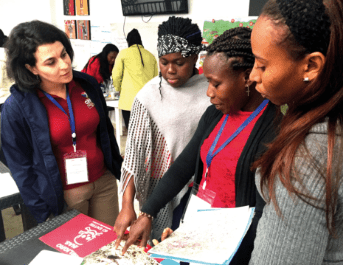
Bearing in mind that women are both direct and indirect victims of this harsh reality, the First Meeting of Women Facilitators representing the priority municipalities of the department of Chocó was held in Bogotá — an event at which we successfully applied the “Portfolio of women's assets and capabilities” methodology, which seeks to recognise and give visibility to women in their role as facilitators, and to recognise how values, norms and roles have socially and historically defined the relationships, activities and social functions that women are expected to carry out.
Recognising that women are both direct and indirect victims of this harsh reality, the First Meeting of Women Facilitators representing the priority municipalities of the department of Chocó was held in Bogotá — an event where we successfully implemented the “Portfolio of women's assets and capabilities” methodology
First, the facilitators identified the different gender roles they play in their territories and, from these, the level of risk, exposure and vulnerability they face in relation to antipersonnel mines or unexploded ordnance. Then, through a range of activities and starting from who they are, what they do and what they can do, this group of women was empowered in their role as leaders, to encourage other women to recognise themselves as people who can have an influence not only on their personal and family life, but also on their community, through participation in their territories and in community organisation — all with a view to minimising risks in their territories, and especially to reducing women's vulnerability factors by approaching Community Risk Management Education from a gender perspective.
This experience allowed this group of women facilitators to leave their territories (some for the first time) to meet and interact with other women like them, learn from the topics covered and discover the “power” they could find by growing collectively, building their self-esteem, feeling heard and broadening their knowledge. They are now knowledgeable about — and able to pass on — the prevention and promotion of safe behaviour in areas contaminated by antipersonnel mines (APM), unexploded ordnance (UXO) and booby traps (BT). For CIREC Foundation they will always mark a milestone and stand for a pioneering, innovative project: the first time Antipersonnel Mine Risk Education (MRE) was delivered with a gender focus.
“Having lived and learned this, my mission will be to save my community from this scourge of antipersonnel mines”.
from Bojayá